Choosing a suitable coating for a concrete floor is an important decision for businesses that want to maintain clean, durable, and professional working environments. Warehouses, factories, garages, and commercial buildings all experience different levels of surface wear and environmental exposure. Selecting the right floor coating paint helps businesses address these requirements while improving the appearance and maintenance of their floors. Before purchasing materials, buyers should understand the available formulations, application methods, and performance characteristics.
Identify Your Flooring Requirements First
Every flooring project starts with a different set of requirements. A warehouse may need a coating that handles forklifts and heavy equipment, while a showroom may prioritize a smooth, glossy finish. Manufacturing facilities might require additional protection against oils, cleaning chemicals, or accidental spills.
Buyers should consider several factors before selecting a product:
- Expected foot traffic and vehicle movement
- Exposure to chemicals, oils, and moisture
- Indoor or outdoor installation conditions
- Required surface texture and appearance
- Cleaning frequency and maintenance expectations
These details help determine which resin technology and coating structure are appropriate.
Explore Popular Floor Coating Paint Options
Different resin formulations are designed for different flooring applications.
Epoxy Floor Coating
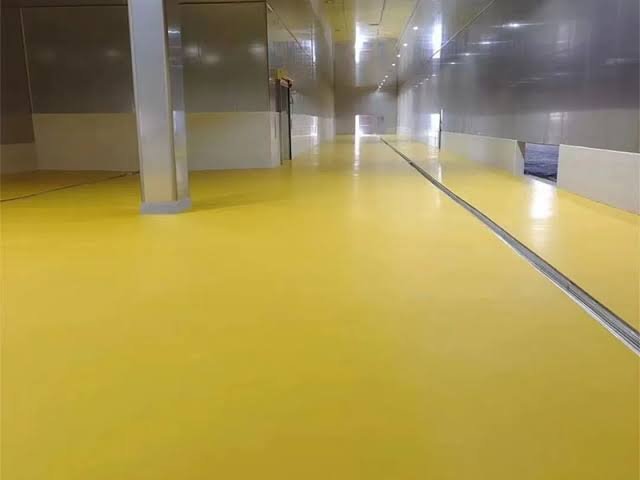
Epoxy is commonly selected for indoor industrial and commercial floors. It offers strong adhesion to properly prepared concrete, a hard finish, and resistance to many chemicals. Self-leveling epoxy products are particularly useful when a smooth, seamless surface is required.
Polyurethane Floor Coating
Polyurethane coatings provide flexibility and abrasion resistance in suitable formulations. They can be considered for floors that experience regular movement, surface wear, and cleaning. Certain polyurethane topcoats also offer improved resistance to sunlight and discoloration.
Polyaspartic Floor Coating
Polyaspartic materials are known for their fast-curing properties and UV stability in suitable formulations. They are often used as protective topcoats in projects where installation speed, surface durability, and color stability are important.
The most suitable option depends on the complete flooring design and the manufacturer’s application recommendations.
Understand the Importance of Primer, Midcoat, and Topcoat
Industrial flooring projects frequently use a multi-layer structure to achieve the desired performance.
Primer: The primer prepares the concrete and establishes adhesion between the substrate and the following layers. Specialized moisture vapor barrier primers can be considered when concrete moisture conditions require additional protection.
Midcoat: This layer builds thickness and helps create a uniform surface. It can also act as a binder for decorative materials such as colored flakes, quartz, or metallic pigments.
Topcoat: The topcoat forms the exposed surface. Depending on its formulation, it can contribute to abrasion resistance, chemical protection, UV stability, and the final gloss level.
Using compatible products throughout the system is essential for reliable results.
Consider Seasonal Conditions Before Installation
Temperature affects the application and curing of resin coatings. Hot weather may shorten working time, while colder conditions can increase material viscosity and slow curing.
Some manufacturers provide summer-grade and winter-grade formulations to address these challenges. Summer-grade materials may help maintain workable application characteristics in higher temperatures, while winter-grade products are developed for improved flow and curing under colder conditions.
Contractors should always follow the specified temperature, humidity, mixing, and curing requirements for the selected product.
Prepare the Concrete Surface Properly
Even a high-quality coating may fail if the concrete is poorly prepared. Dust, oil, loose particles, cracks, and excessive moisture can affect adhesion and surface performance.
Mechanical grinding is commonly used to remove contaminants and create an appropriate surface profile. Cracks and damaged areas should be repaired using compatible materials. Moisture testing should also be completed before selecting the primer and coating system.
Proper preparation creates a suitable foundation for the remaining layers.
Choose a Supplier with Technical Support
For contractors, distributors, and flooring businesses, a reliable supplier should provide clear product specifications and application guidance. JINCHENG offers epoxy, polyurethane, and polyaspartic flooring materials, including primers, midcoats, topcoats, and seasonal formulations.
Buyers can request technical data sheets, safety information, mixing instructions, and samples before placing bulk orders. OEM and private-label options may also be useful for businesses developing their own flooring product ranges.
Conclusion
Buying industrial floor coating paint requires careful consideration of the working environment, resin formulation, coating layers, and installation conditions. By evaluating these factors and choosing compatible materials, businesses can develop flooring solutions that meet their operational needs while supporting long-term surface protection.